Sovereign AI Quarterly Update #3


This is my third update on our progress at Sovereign AI. As before, this represents my own views on our work.
Sovereign AI was set up with a simple thesis: adopting and developing frontier AI is a strategic national priority, and to do this the UK must be home to more companies building critical parts of the global AI supply chain. Alongside improving the general business environment, we believe the Government can do this by investing directly into British frontier AI companies, and by providing strategic support only the Government can offer so that the best teams can build and scale here to compete globally.
This is the first full quarter since our launch in April, and one where we have hit our targets on the investment side and team build out. We have now invested in, or are in final legals with, 12 UK AI companies, with 5 announced so far. We have an enviable 100% win rate and our portfolio companies have raised a combined £4B. More on this below.
It’s also been a strong quarter for the wider British AI ecosystem. UK AI companies raised a record £10 billion in the first half of 2026. That is more than four times what was raised in the same period last year. The UK attracted 39% of all European venture investment and now has multiple teams that have raised over $1B building frontier-models in fields as diverse as material science discovery to autonomous vehicles.
And it’s also been a strong quarter for the impact of these new technologies across the UK. British Chambers of Commerce research found that a vast majority of SMEs now actively use AI, with adopters seeking significant productivity gains. There’s been breakthroughs in adoption in the public sector too. Kent and Canterbury Hospital became among the first in the NHS to use an AI tool that spots infections before they take hold. A survey of 1,000 NHS healthcare professionals published this month found nine in ten are already using AI in their work to cut through the 1.3 hours (!!) of admin they average on top of a full day of patient care, with seven in ten saying it is reducing their bureaucratic burden. In June, Extract, an AI tool built by the government's AI incubator, was launched to every council in England, and a companion tool is now being tested in three councils to half the time a routine household planning decision takes. This is the everyday impact we want to see, and can all benefit from.
Globally, this quarter has been one of increased capabilities and demand, alongside mind-melting breakthroughs in maths in particular. And while performance of the frontier models improves, many use cases are also getting cheaper, thanks to the continued competitiveness of open-weight models (which are generally, if not always cheaper to run), more efficient approaches to compute and a competitive set of frontier model companies dropping prices over time.
So, by any account, generative AI models and the chips that run them continue to be one of the most important areas of investment to improve our health and economic and national security in the world today.
However, the UK still faces significant challenges in its effort to benefit from this technology, and the economic and security risks remain stark. In the last three months alone we have seen numerous examples of these national vulnerabilities play out. Export-restrictions have been placed on frontier models. The cyber capabilities of these models have increased significantly, improving the ability to defend against cyber-attacks for those who know how to use them, but increasing the risks of security breaches for those who don’t - with a growing number of serious incidents reported. While capable open-weight models provide welcome alternatives to closed systems, almost all of these originate from China-based labs creating another risk of over reliance on a single nation for our AI capabilities. And even efforts to access frontier models from other countries like Japan have been thwarted by basic issues like outdated GDPR requirements.
While the UK has seen continued investment and has strong fundamentals, companies here remain behind peers in the US & China in terms of the capital available to them and broad adoption to date. The capital being invested into this space globally, in particular the amounts being spent on data, chips and datacentres, is set to be the single largest capital expenditure project in modern history. We still have too few strategically valuable companies in critical areas like frontier models, chips and compute.
So, despite great progress, it remains urgent for our national security and economy that the UK continues to support founders to build the models, chips and supporting infrastructure required for the safe adoption of this technology. In short, while we are optimists at Sovereign AI about Britain’s position and potential, we are sober about the importance and urgency of the work we are doing.
Quarterly Report #3
Investments
Since the last update we have publicly announced three further investments.
OLIX is building a new approach to compute that integrates SRAM architecture with photonics, tackling the memory and energy constraints that today's GPU architectures are running into.
Cusp AI is building AI models to develop new materials, using molecular simulation to design advanced materials starting with energy and sustainability use cases.
Isomorphic Labs is the most advanced AI drug discovery company in the world, led by Sir Demis Hassabis and developing novel therapeutics to tackle disease.
We have done this with 3 fulltime, and very hard working, investment professionals.
It is hard to judge a portfolio of work after just a few months, but between our five announced companies, and the seven in final legals, the portfolio is starting to take shape in line with our original goals. A few observations on it:
First, on our priority sectors. The portfolio maps closely to the focus areas we published at launch: several companies in Compute and Infrastructure, several building new Frontier Model architectures, two in AI for Health and Life Sciences, two in Scientific Discovery, and companies whose work directly supports trust and security in AI deployment.
The stages range from pre-seed through to Series C, which is exactly the early-stage, high-conviction profile we set out to build. The later stage companies have been announced first, this is the nature of building a new pipeline of investments, but going forward we will have far more seed and Series A stage companies, in line with the risk profile we wish to take. Each one, if successful (and we appreciate it is always a big if ) could have a significant impact on the AI economy on a global scale, and we believe can contribute significantly to the UK’s position in it. It is great to see patriotic founders and teams willing to take a bet on a new initiative like SovAI, and we’re grateful to everyone who has applied for funding, even if we can only support a few.
Of the twelve companies, all have their headquarters in the UK, and eleven will have a UK legal top-co ( we made a notable exception for Isomorphic, who are based here and are investing heavily into UK life sciences and AI). Amongst the portfolio we are supporting two companies to ‘flip’ into UK legal jurisdiction after establishing elsewhere. As we have always made clear, we require a heavy UK presence and compliance with UK law, including copyright law which is reviewed as part of our due diligence process and an issue we will seek additional legal guidance on where relevant. As should be obvious, this will often not be a relevant question - asking a chip developer to make specific legal representations about copyright law makes as much sense as asking a fighter-jet developer to make specific representations about fruit & veg law.
I mention the latter points in particular as there have been a couple of inaccurate articles on these topics. We get corrections to such articles where we can but we are a small team so can’t always respond in time. In fact the Economist ran a good piece this week on the asymmetric nature of this issue. It’s been eye-opening to see how often FOI requests are misused, costing taxpayers’ money and civil servants' time. I hope transparent updates like this reduce the opportunity to abuse a well-intentioned and important tenant of Government transparency.
Our offer to founders
Providing capital is only a small part of what we aspire to do, and the next quarter will be about delivering on our wider offer to founders.
Compute. Demand for our compute programme, run by the AI Research Resource, has been extraordinary: hundreds of applications requesting many multiples of the entire year's allocation. Alongside time on Isambard-AI, the UK's most powerful supercomputer, we now provide cloud credits so that companies can access more usable capacity flexibly, in the form that fits their workloads where Isambard hasn’t been a fit.
Rapid Procurement Challenges. In the coming weeks we will launch our first procurement challenges, where we have worked with other Government departments to set out problems they need solved and will invite UK AI companies to compete to solve them, with SovAI as the paying customer. Procurement and advance market commitments like this remain one of the most powerful levers any government has to spur innovation, and we have spent this quarter working on what we think will be the first ever series of procurement challenges focussed on British start-ups. It seems common sense that the Government should be able to procure innovative solutions from start-ups, not just established companies, but the work that has had to go into making this possible is extraordinary, and while it will be a drop in the ocean of Government spend initially, I hope it forms the foundation of a much bigger change in Government’s approach to buying frontier-technologies. Follow the SovAI accounts and website. We will share more at launch in the coming weeks.
Nationwide launch events. We followed up on our successful launch in Kings Cross in April with further AI community events in Newcastle, Glasgow, Cardiff and Manchester in the last three months - meeting with hundreds of ambitious founders along the way. We are planning more events like this throughout the rest of the year.
The SovAI job board. We have launched a jobs page on our website surfacing live roles across the portfolio. If you want to work at the frontier of British AI, whether as a laser architect in London ( yes it's a thing!) or director of quality in Bristol, start there. While there are only c.60 live roles in the UK at the moment, this number and the geographic spread will grow significantly in the coming months as we announce more investments.
Team. We have adapted to the organisational changes in Government in the last few weeks. We have a new Deputy Director fully onboarded alongside our Managing Partner, and we have several new hires joining in the coming weeks across the investment and platform functions, with more announcements to follow. The calibre of people wanting to go into public service and leave exceptional private sector jobs is inspiring. Open roles are always listed on the website.
I expect in the next quarter we will see an even faster increase in model performance, with falling token costs driven by local models. In particular we are monitoring progress in recursive self-improvement, embodied AI (world models & robotics), cyber defence and more efficient compute. We are continuing to refresh these areas of focus to match our goal and we are grateful for the engagement, the challenge and the support on this we have had.
As ever, this update reflects my own views, and if you'd like to get involved, the website is the front door.
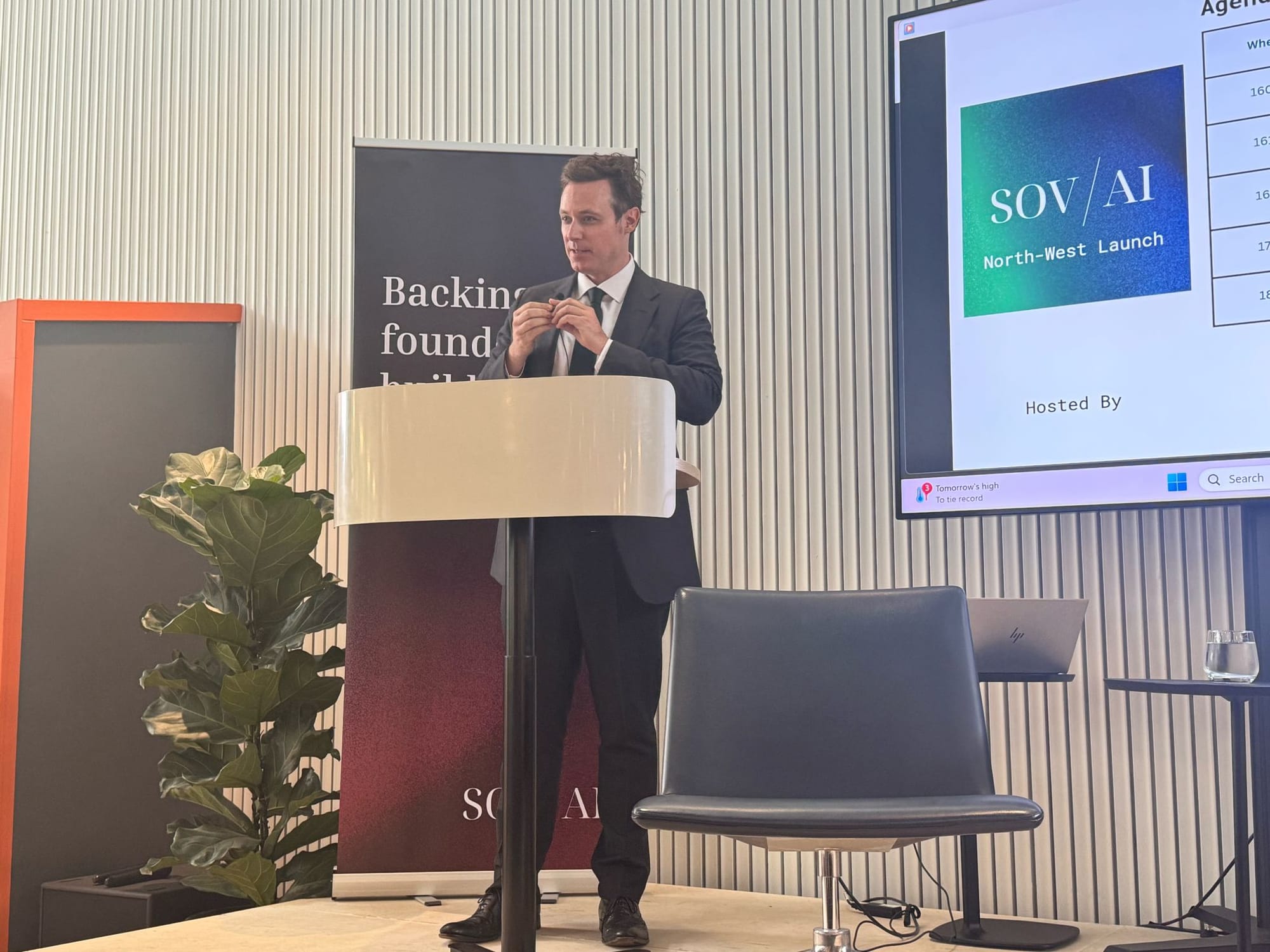
Me trying to get a mic working at SovAI's Launch in my home town of Manchester - even AI can't get a simple audio set up working.