Baumol remains undefeated

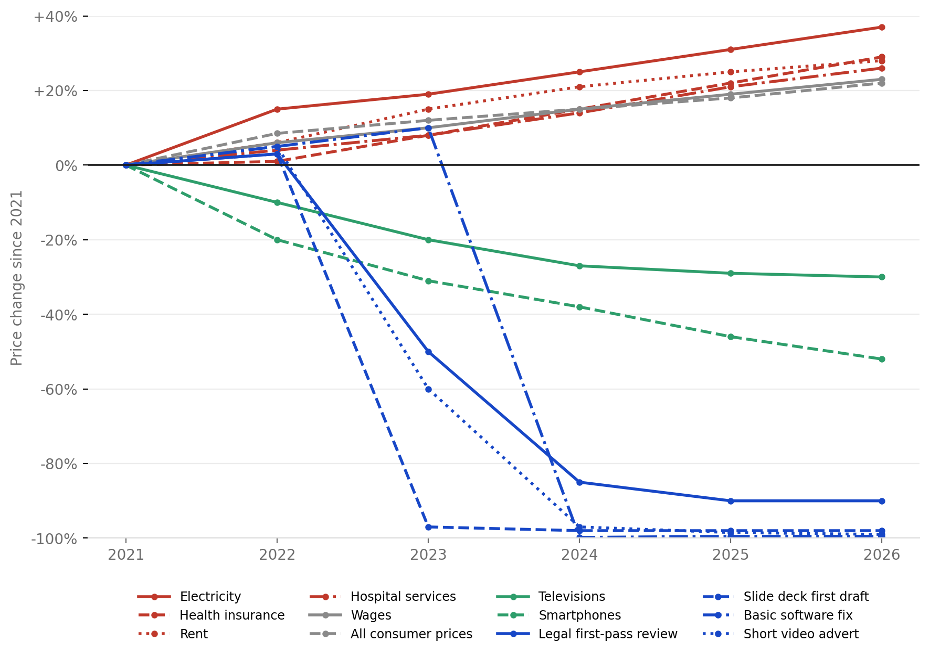
( Price change since 2021, United States. Red: the things you need to live. Grey: prices overall. Green: traditional tech. Blue: Useful services you need to start a business impacted by AI. Sources at the foot of the post. )
Five years ago, the first draft of a slide deck cost you a day of a designer’s time. It now costs about a pound. A software fix that took a developer an afternoon can be done by an agent for even less. A first pass over a commercial contract has gone from an associate's hourly rate to a few cents of compute. A usable, thirty-second Instagram advert that once needed a day's shoot can be generated in the time it takes to watch a thirty-second Instagram advert.
The rapid increase in AI capabilities matched by the rapid fall in the cost of compute has dramatically increased the affordability of what were once extremely expensive goods & services – code, video, legal opinions and executive support at a speed that would make Moore’s law blush. Generative AI is, on this metric at least, one of the most democratising technologies ever invented. As a result of this ( and broader shifts ), more people are choosing to start a business than ever, creating more jobs in the process and requiring even less capital to get going.
Why then, does almost no-one feel richer?
Over the same five years the price of electricity is up nearly 40 per cent. Rent, hospital care and health insurance are up by more than a quarter. Wages have fallen behind, so the average household is standing still while its biggest bills sprint ahead. In Britain you could add water bills, business rates, council tax and the train fares all up as well.
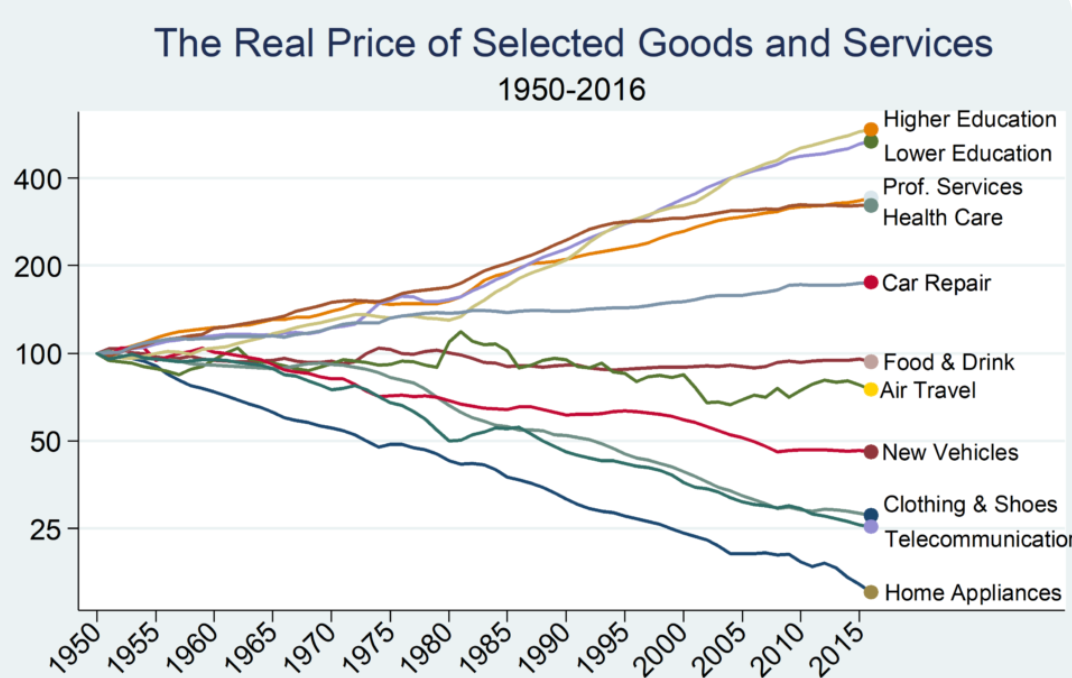
Baumol’s cost disease, also known as ‘The Chart of the Century’, is one of the most haunting images in economics. And the advent of AI seems to have made the challenge even starker.
It's got alot cheaper to start a business, it's got alot more expensive to live.
Why, with close to a trillion-dollars in investment and astonishing breakthroughs in the last few years, hasn’t AI touched the red lines?
Yes, there are macro factors. Multiple countries are at war. Tariffs have increased prices for many goods. Demand for some rare earths mineral has exploded while supply has been constrained. But the overwhelming answer in many cases is still, sadly, regulation. Housing is expensive because we have made it hard and slow to build. Power is expensive because it takes a forever to connect new generation to an inefficient grid. Healthcare is expensive because the people who provide it are rarely allowed, or can afford, to adopt new technologies.
This is why politicians can rail against these new technologies, even when it is making many aspects of our lives better. Look at Bernie Sanders, a man who has spent half a century saying he desperately wants to make life cheaper for working people, fighting services that have made everything from expert legal advice to personal tutors, once the privilege of the wealthy, too cheap to meter. We did it! But because so many of life’s necessities have got more expensive, nobody feels it.
Regulation may be the challenge, but we can’t just rely on that changing. At Balderton, we’ve long invested in companies that are trying to bring those red curves down – in financial services, energy and healthcare. If you’re trying to do that too, get in touch.
Sources and method. Red, grey and green lines are US Bureau of Labor Statistics CPI series, July of each year (electricity, rent of primary residence, hospital services, televisions, smartphones, all items, average hourly earnings); health insurance is the KFF Employer Health Benefits Survey average family premium. Several series are compounded from published annual changes and may differ by a point or two from the index levels.